

The Hidden Digital Witness Inside Every Big Rig
Key Takeaways: A semi-truck "black box" is not one device but a set of onboard systems, the engine control module, dedicated event data recorders, and the federally mandated electronic logging device, that together record speed, braking, throttle, engine hours, and duty status around a crash. In New Mexico, this data helps reconstruct collisions, test for fatigue or hours-of-service violations, flag maintenance faults, and confirm or contradict a driver’s account. Because the ELD mandate under 49 C.F.R. Part 395 applies to most interstate carriers nationwide, subject to exemptions like short-haul operations, pre-2000 engines, and driveaway-towaway moves, out-of-state carriers on I-40 and I-25 may face the same recording obligations. The central challenge is preservation: ECM event memory can be overwritten by continued driving, ELD supporting documents are generally kept only six months, and the hardware stays under the carrier’s control, so prompt spoliation letters and formal discovery are often necessary. Even once obtained, the data must clear authenticity and reliability hurdles and is strongest when layered with maintenance files, dispatch records, and driver qualification documents. Acting quickly after a commercial vehicle collision can determine whether this evidence still exists when it matters.
A semi-truck’s "black box" is an onboard electronic system recording what the truck and driver were doing around a crash, and in New Mexico that data can become some of the most persuasive proof in an injury or wrongful death claim. It may come from the engine control module (ECM), a dedicated event data recorder, or the federally required electronic logging device, together showing speed, braking, throttle position, engine hours, and how long the driver had been behind the wheel. Because carriers control that hardware after a collision, how quickly an injured person acts can shape whether that evidence still exists when it matters.
If you or a loved one was hurt in a collision with a commercial vehicle near Albuquerque, Smith & Marjanovic Law can help you understand what data may exist and how to seek its preservation. Call (505) 510-4440 or contact us now to discuss your situation.
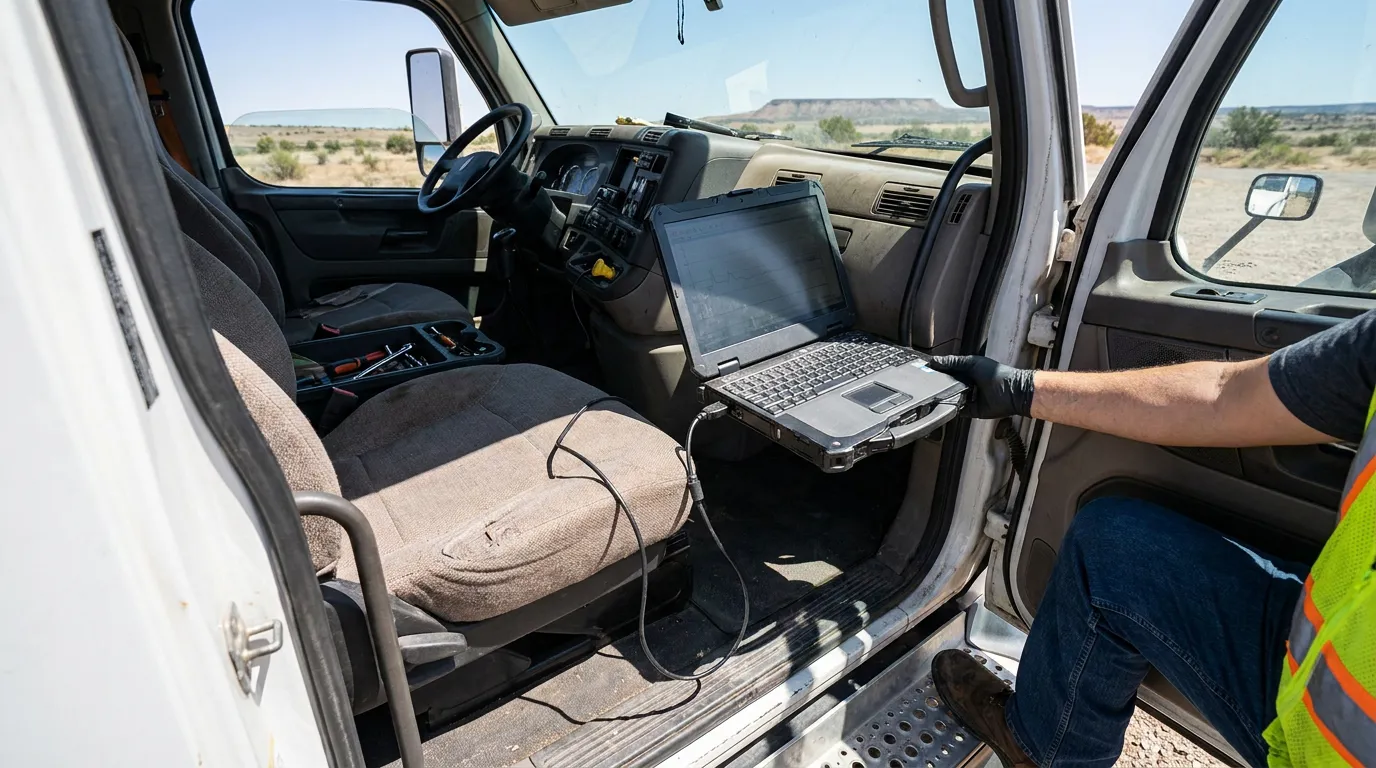
What Is a Truck Black Box, in Plain Terms
The phrase "black box" is shorthand, not a single device. In most tractor-trailers, recording functions spread across several electronic components designed for engine performance and regulatory compliance rather than litigation. Lawyers and reconstruction engineers rely on this data because it captures machine behavior with precision human memory rarely matches, though what any given tractor stores varies by manufacturer and configuration.
Engine Control Module Data
The engine control module is the truck’s central computer. It manages fuel delivery and engine performance while continuously monitoring conditions, and many units store snapshots when a hard-braking or sudden-deceleration event occurs. ECM data may reflect road speed, RPM, brake application, cruise control status, and fault codes. Unlike passenger-vehicle event data recorders governed by 49 C.F.R. Part 563, heavy-truck ECM recording is not standardized by federal regulation, so captured fields and recorded windows differ from engine to engine.
Electronic Logging Devices and Federal Requirements
Electronic logging devices are federally mandated for most interstate drivers and form a major piece of the black box picture. Under 49 C.F.R. Part 395, most interstate commercial drivers who must keep duty-status records use an ELD instead of paper logs. Exceptions include the short-haul exemption, drivers who complete paper logs on eight or fewer days within any 30-day period, driveaway-towaway operations, and vehicles with engines older than model year 2000. These devices automatically record driving time by synchronizing with the engine, capturing engine hours, vehicle motion status, miles driven, and location at set intervals rather than continuously.
Why the Federal Rule Matters in Albuquerque Cases
The ELD mandate applies uniformly to covered interstate operations nationwide, so trucks rolling through New Mexico may face the same recording obligations as trucks anywhere else. A carrier based in Texas or Arizona hauling freight along I-40 or I-25 generally cannot argue different data standards apply here, though it may argue a specific exemption applies. That uniformity can give injured New Mexicans a consistent baseline when requesting truck crash data New Mexico carriers maintain.
How Semi Truck Black Box Data Evidence Is Actually Used
Investigators, insurers, and courts may use this information to reconstruct the collision second by second. A reconstruction engineer may compare recorded speed against posted limits, measure whether the driver braked before impact, and evaluate throttle input in the final moments. When the machine record conflicts with a driver’s statement, the discrepancy itself can become significant, though recorded values still require calibration checks and expert interpretation before being treated as reliable.
Common uses of semi truck black box data evidence include:
- Establishing pre-impact speed and whether the truck was exceeding safe limits for conditions
- Showing whether, when, and how hard the driver applied the brakes
- Confirming engine hours and duty status to test for fatigue or hours-of-service violations
- Corroborating or contradicting witness accounts and the driver’s version of events
- Identifying mechanical fault codes that may point toward negligent maintenance
New Mexico law also creates a statutory backdrop for these investigations. Section 66-7-201 (NMSA 1978) generally requires a driver involved in an accident resulting in injury or death to stop at or near the scene, remain there until requirements of Section 66-7-203 are met, and provide identifying information and reasonable assistance. When a driver’s account of duties after an injury accident is disputed, recorded data may help verify timing, speed, and braking details. A statutory violation does not by itself establish civil liability; causation and damages must still be proven.
💡 Pro Tip: Photograph the tractor’s unit number, license plate, and DOT number at the scene if possible. Identifying the specific tractor makes it easier to pinpoint which recording systems may hold relevant data.
The Preservation Problem: Why Timing Drives Everything
Black box information does not sit untouched indefinitely. ECM event memory can be overwritten by continued operation, and carriers are generally required under 49 C.F.R. § 395.8 to retain duty-status records and supporting documents for only six months. If the tractor returns to service, is repaired, or is sold, useful information may become unrecoverable.
Spoliation and the Duty to Preserve
Once a carrier knows or reasonably should know litigation is likely, a duty to preserve relevant evidence may arise. Legal commentary and New Mexico case law have addressed how ECM and event data recorder information is obtained, preserved, and admitted in litigation, including spoliation questions when that data disappears. New Mexico is unusual in recognizing intentional spoliation as an independent tort, while negligent destruction claims are generally analyzed under ordinary negligence principles requiring an independent duty. Courts may also consider whether loss was inadvertent or resulted from failure to honor a preservation obligation, and remedies, ranging from no relief to an adverse-inference instruction, depend heavily on the specific facts.
A prompt, written spoliation letter is often the practical first step, though it is not itself a court order and does not compel compliance. Counsel may also pursue formal discovery, and in some cases court intervention, to require download of the module by a neutral or agreed-upon technician. Success depends on the case’s posture and the trial court’s discretion.
Access Is Rarely Voluntary
Injured people generally cannot download this data themselves. Retrieval typically requires manufacturer-specific software, cabling, and trained personnel, and the hardware sits in a vehicle controlled by the carrier or its insurer. Attempting access without authorization or a court order can raise its own legal problems. Carriers often send their own investigators to the scene quickly, so the injured party is frequently starting from behind.
| Data Source | Typical Information Captured | Common Preservation Concern |
|---|---|---|
| Engine control module | Speed, RPM, braking, throttle, fault codes | Event memory may be overwritten with continued driving |
| Electronic logging device | Driving time, engine hours, motion, miles, location | Retention limited to regulatory periods |
| Telematics or fleet systems | GPS position, routing, speed trends, alerts | Held by third-party vendors under contract |
Fitting Black Box Records Into a Broader Liability Picture
Recorded data rarely stands alone. Serious commercial vehicle cases usually involve multiple potentially responsible parties, including the driver, the motor carrier, a maintenance contractor, and sometimes the entity that loaded the cargo. Machine data may become most powerful when layered with maintenance files, dispatch communications, training records, and driver qualification documents.
Duty-status records deserve particular attention. Reviewing whether truck driver logbooks prove fault alongside ELD output may reveal inconsistencies suggesting a driver worked beyond permitted hours or that a carrier pressured unrealistic schedules. Those inconsistencies may support theories of negligent supervision or negligent entrustment, though every theory must be proven with admissible evidence, and a carrier’s admission of vicarious liability can affect whether such direct-negligence claims proceed.
Admissibility Is Not Automatic
Data must still clear evidentiary hurdles before a jury sees it. A party offering ECM or ELD output generally must establish authenticity under Rule 11-901 NMRA, address hearsay concerns through an applicable exception such as the business records rule, show reliability of the download process, and present a qualified witness to interpret the output under Rule 11-702 NMRA. Legal commentary and New Mexico evidentiary standards address how technology-driven proof is evaluated, and outcomes remain fact-dependent rather than uniform.
💡 Pro Tip: Keep your own contemporaneous notes about weather, road conditions, and what you observed. Human observations that align with recorded machine data tend to strengthen the overall narrative.
Practical Steps After a Commercial Vehicle Collision
Focus first on medical care, then on protecting the record. Prioritize evaluation and treatment, because untreated injuries can create both health risks and gaps insurers may later exploit. Once stable, preserving evidence becomes the central concern.
Consider these measures, subject to your own circumstances:
- Report the crash and obtain the law enforcement report number
- Avoid giving a recorded statement to the carrier’s insurer before understanding your rights
- Save all medical records, bills, and proof of missed work
- Move quickly on evidence preservation requests, since delay can be irreversible
A firm handling semi truck black box data evidence lawyer matters can send preservation demands, retain reconstruction professionals, and coordinate inspection of the tractor. Timely action matters because data already overwritten generally cannot be recovered. New Mexico’s general three-year limitations period for personal injury and wrongful death claims is a separate and much longer deadline than the practical window for securing this data, and shorter notice requirements can apply if a government entity is involved.
Frequently Asked Questions
1. Does every semi-truck have a black box?
Not necessarily. Most modern tractors have an ECM, and most interstate trucks subject to duty-status rules use an ELD, but the specific data recorded varies by manufacturer, model year, and configuration, and some operations are exempt from the ELD rule entirely. An inspection is generally needed to determine what exists.
2. How long does black box data last after a crash?
It depends on the system. ECM event memory can be overwritten by continued operation, sometimes within days, while federal rules generally require carriers to keep duty-status records for six months. This variability is why preservation requests are typically sent as early as possible.
3. Can a carrier refuse to hand over ECM data?
A carrier may resist informal requests, which is why formal discovery exists. Courts may compel production of relevant, non-privileged information, and unexplained destruction after a preservation duty arises can carry consequences. Any specific remedy depends on the facts and the court’s assessment.
4. Is black box data enough to win a truck accident case?
Rarely by itself. Data may help establish what the truck did, but liability also requires proof of duty, breach, causation, and damages, often supported by maintenance records, driver files, and medical evidence. Outcomes always depend on the specific circumstances.
5. What if the police report blames me?
A police report reflects an officer’s preliminary assessment, is not the final word on civil liability, and may itself be inadmissible or admissible only in part at trial. Recorded truck data sometimes contradicts initial conclusions. New Mexico follows a pure comparative fault system, which may allow recovery even when a plaintiff bears a substantial share of responsibility, with damages reduced by that percentage.
Turning Machine Records Into Meaningful Answers
Semi-truck black box information can transform a disputed collision into a documented sequence of events, but generally only when someone acts fast enough to secure it. The ECM, the ELD, and fleet telematics each capture a different slice of the story, and each carries its own preservation risk. Injured New Mexicans may face carriers with immediate access to that hardware and experienced defense resources, which can make early legal guidance particularly valuable. Every case turns on its own facts, and no article can predict how a specific claim will resolve.
If you are trying to understand what a commercial truck’s data might reveal about your crash, Smith & Marjanovic Law is available to review your options. Reach the firm at (505) 510-4440 or visit Smith & Marjanovic Law’s website to request a consultation before critical evidence disappears.
Disclaimer: This content is for informational purposes only and is not legal advice. Every case is unique, and results may vary. Consult an attorney about your specific circumstances.