
The Federal Insurance Safety Net Behind Big-Rig Crash Claims
Key Takeaways: The MCS-90 endorsement is a federally required attachment to a motor carrier’s liability policy that compels an insurer to pay, up to stated limits, a final judgment for public liability caused by negligent operation of a commercial truck subject to federal financial responsibility rules. Most courts treat it as suretyship protecting the public rather than traditional coverage, meaning it does not require the insurer to defend the carrier and allows the insurer to seek reimbursement afterward. It can apply even when the specific truck is not listed on the policy and regardless of the carrier’s insolvency. This matters in Albuquerque semi-truck cases because federal minimums for many interstate carriers start at $750,000, far above New Mexico’s $25,000/$50,000/$10,000 auto minimums. Because outcomes are fact-dependent and litigated differently across jurisdictions, prompt evidence preservation and full policy review are essential.
When a loaded tractor-trailer causes catastrophic injuries on I-40 or I-25, families ask whether there will be enough insurance to cover a lifetime of medical care. The MCS-90 endorsement is a federally mandated attachment to a motor carrier’s liability policy that functions as a backstop, requiring a trucking company’s insurer to pay a final judgment for public liability arising from negligent operation of a commercial vehicle, even when the underlying policy might otherwise provide no recovery. Whether it applies depends on the facts, the carrier’s operations, applicable case law, and specific policy language.
If you or a loved one were seriously hurt by a commercial truck, the attorneys at Smith & Marjanovic Law can help you identify every layer of available coverage. Call (505) 510-4440 or contact us now to discuss your situation.
What the MCS-90 Endorsement Actually Promises
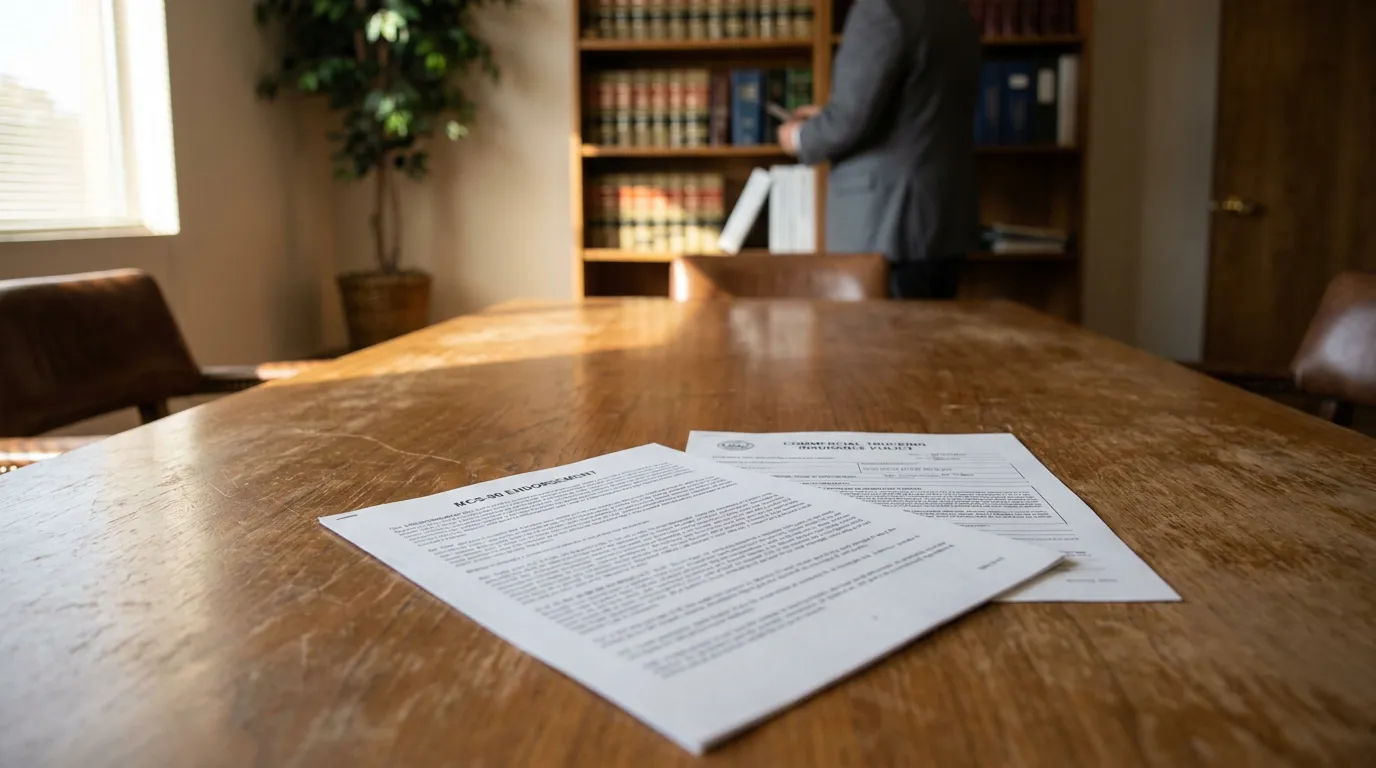
The endorsement is a written promise by the insurer to pay judgments for public liability, not a traditional coverage grant. Under the federal public liability endorsement form, the insurer agrees to pay any final judgment recovered against the insured for public liability resulting from negligence in the operation, maintenance, or use of motor vehicles subject to the financial responsibility requirements of Sections 29 and 30 of the Motor Carrier Act of 1980. That obligation is capped at the limits stated in the endorsement’s schedule.
Two features matter enormously to injured claimants. First, the obligation applies regardless of whether each motor vehicle is specifically described in the policy and whether the negligence occurs on any authorized route or territory. Second, the insurer must pay irrespective of the financial condition, insolvency, or bankruptcy of the insured. This means a small carrier folding after a devastating crash does not automatically extinguish a victim’s recovery path, though the endorsement generally requires a final judgment before the insurer’s payment duty arises.
Why Courts Call It Suretyship Instead of Coverage
Federal courts have generally described the MCS-90 as suretyship rather than ordinary insurance. In one decision analyzing the endorsement, the court characterized it as suretyship by the insurance carrier to protect the public, a safety net triggered when the attached policy provides no coverage to the insured. That framing explains why disputes often arise only after an insurer denies coverage under the base policy.
This distinction carries real consequences. An MCS-90 does not obligate an insurer to defend or indemnify its insured; rather, the insurer must pay any judgment awarded against the policyholder subject to a right of reimbursement. The FMCSA form itself states that the insured agrees to reimburse the company for any payment made on account of any accident, claim, or suit involving a breach of the policy terms. The money flows to the injured person first, with the insurer later pursuing the carrier separately.
Unsettled and Fact-Dependent Questions
Not every MCS-90 issue has a settled answer. Courts across the country have not resolved every application uniformly, and outcomes may turn on whether the trip was interstate, whether the vehicle met the weight and cargo thresholds that make it subject to federal requirements, and whether other applicable insurance was available to the injured claimant.
How an MCS-90 Endorsement Truck Accident Claim Differs From an Ordinary Car Crash
The gap between state minimum auto insurance and federal trucking financial responsibility is dramatic. New Mexico’s state vehicle insurance requirements set minimum liability limits of $25,000 for bodily injury to or death of one person and $50,000 for bodily injury to or death of two or more persons, with $10,000 for property damage. Federal financial responsibility minimums for many interstate for-hire carriers hauling non-hazardous property in vehicles with a gross vehicle weight rating of 10,001 pounds or more begin at $750,000 and rise to $1,000,000 or $5,000,000 for certain hazardous cargo. For a client facing spinal surgery and permanent disability, that difference determines whether meaningful truck crash compensation NM families need is realistically available.
| Feature | New Mexico Minimum Auto Policy | Federal Motor Carrier Requirement |
|---|---|---|
| Governing authority | State motor vehicle insurance rules | Motor Carrier Act of 1980, 49 C.F.R. § 387.7 |
| Typical minimum | $25,000 / $50,000 / $10,000 | Generally $750,000 or more, by cargo type |
| Vehicle listing | Coverage tied to described vehicles | Applies regardless of vehicle description |
| Insolvency of insured | May limit practical recovery | Payment obligation continues |
| Proof of compliance | Form MCS-90 endorsement, MCS-82 surety bond, or approved self-insurance | State insurance database reporting |
Compliance monitoring also runs on two separate tracks. New Mexico tracks ordinary vehicle insurance through the Insurance Identification Database. Federal filings for interstate carriers operate independently, and a carrier may be subject to both systems. Readers can review whether federal DOT laws override state rules in a given situation.
💡 Pro Tip: Ask early whether the truck was operating in interstate commerce at the time of the crash. That single fact often shapes which financial responsibility framework applies.
Alternative Ways Carriers Prove Motor Carrier Financial Responsibility
An MCS-90 endorsement is one federally sanctioned compliance mechanism, not the only one. Federal law and regulation, including 49 U.S.C. § 31139 and 49 C.F.R. § 387.7, contemplate that proof of financial responsibility may consist of a Form MCS-90 endorsement issued by an insurer or a Form MCS-82 surety bond. Some larger fleets self-insure under separate FMCSA authorization. Identifying which mechanism applies is an early investigative step in any serious commercial trucking insurance dispute.
Cancellation is not instantaneous either. The federal form provides that cancellation may be effected by the company or the insured by giving thirty-five days notice in writing to the other party. An endorsement can remain operative during a window when a carrier believes its coverage has lapsed.
Evidence That Supports a Federal Truck Insurance Endorsement Argument
Proving the endorsement applies requires the same records that prove negligence. Preservation letters should go out quickly, because electronic data can be overwritten under routine retention schedules. Commonly critical materials include:
- Driver qualification files, hours-of-service logs, and electronic logging device data
- Vehicle maintenance and inspection records
- Bills of lading and dispatch records showing interstate haul nature
- The complete insurance policy, declarations pages, and every attached endorsement
- Carrier registration filings and surety bond documentation
💡 Pro Tip: Request the full policy, not just the declarations page. The endorsement pages are where the MCS-90 language lives.
Common Obstacles Injured New Mexicans Encounter
Insurers frequently contest whether the endorsement is triggered at all. A common argument is that the base policy, or some other available insurance, already covers the loss, which under the suretyship reasoning could mean the endorsement never activates. Another recurring dispute involves whether the shipment qualified as interstate commerce. These are fact-intensive questions.
Multi-party liability adds another layer of complexity. A single collision may involve the driver, the motor carrier, a broker, a cargo loader, and a maintenance contractor, each with separate policies. Sorting out which entity’s coverage responds, and in what order, is rarely obvious from the crash report alone. Working with a truck accident lawyer Albuquerque families trust can help ensure no responsible party is overlooked.
Timing Considerations Worth Understanding
Deadlines in New Mexico injury cases are governed by civil statutes of limitations, and they are not flexible. Most personal injury and wrongful death claims in New Mexico must be filed within three years, but the applicable deadline can differ depending on the claim and the parties. Claims involving a governmental entity are subject to the New Mexico Tort Claims Act, which imposes separate written notice requirements and shorter filing deadlines. Because the applicable period depends on the parties and the nature of the claim, timing questions should be reviewed promptly.
Frequently Asked Questions
1. Does an MCS-90 endorsement mean the insurer will defend the trucking company?
Not necessarily. Courts have generally explained that the endorsement does not obligate an insurer to defend or indemnify its insured; the obligation is to pay a final judgment against the policyholder, up to the endorsement’s stated limits and subject to the insurer’s right of reimbursement from the carrier.
2. Can I recover if the trucking company goes bankrupt after the crash?
Possibly. The federal form states the payment obligation applies irrespective of insolvency or bankruptcy of the insured. Whether that helps depends on obtaining a final judgment, the endorsement’s applicability, any bankruptcy stay, and the collision facts.
3. What if the specific truck that hit me was not listed on the policy?
The endorsement’s language extends to public liability from negligent operation regardless of whether each motor vehicle is specifically described in the policy. The vehicle and trip must still fall within federal financial responsibility requirements.
4. How does this compare to semi-truck insurance New Mexico drivers carry for personal cars?
State minimum limits are far lower than federal motor carrier minimums. That gap is often the practical reason an MCS-90 endorsement truck accident analysis matters in catastrophic injury cases.
5. Is an MCS-90 the same as a surety bond?
No. A Form MCS-82 surety bond is a separate, federally recognized way to demonstrate motor carrier financial responsibility, and the documentation, parties, and claim procedures differ.
Putting the Pieces Together After a Serious Truck Crash
The MCS-90 endorsement exists because Congress recognized that ordinary insurance disputes should not leave badly injured people without recourse. It operates as a safety net, obligating an insurer to pay qualifying final judgments for public liability up to the endorsement’s limits even where vehicles are unlisted or the carrier is insolvent, while preserving the insurer’s right to seek reimbursement. Its application is fact-dependent and has been litigated differently across jurisdictions, so no article can predict how it will function in an individual Albuquerque semi-truck injury claim. What it can do is show why thorough investigation into every policy, endorsement, and responsible party is essential.
If a commercial truck crash has upended your family’s life, Smith & Marjanovic Law is prepared to examine the coverage layers and pursue accountability. Call (505) 510-4440 or reach out today for a confidential case review.